
Discover the Wild Beauty of Skye’s Dunscaith Castle
- Last Updated:
Dunscaith Castle sits near the western shore of Skye’s Sleat peninsula, just off the single-lane road that threads through Tokavaig. To find it, park where possible, near (///picnic.blink.enable). Follow the road northwest to (///refrained.hologram.droplet).
Follow the path breaking off to follow the coastline and on to Dunscaith Castle.
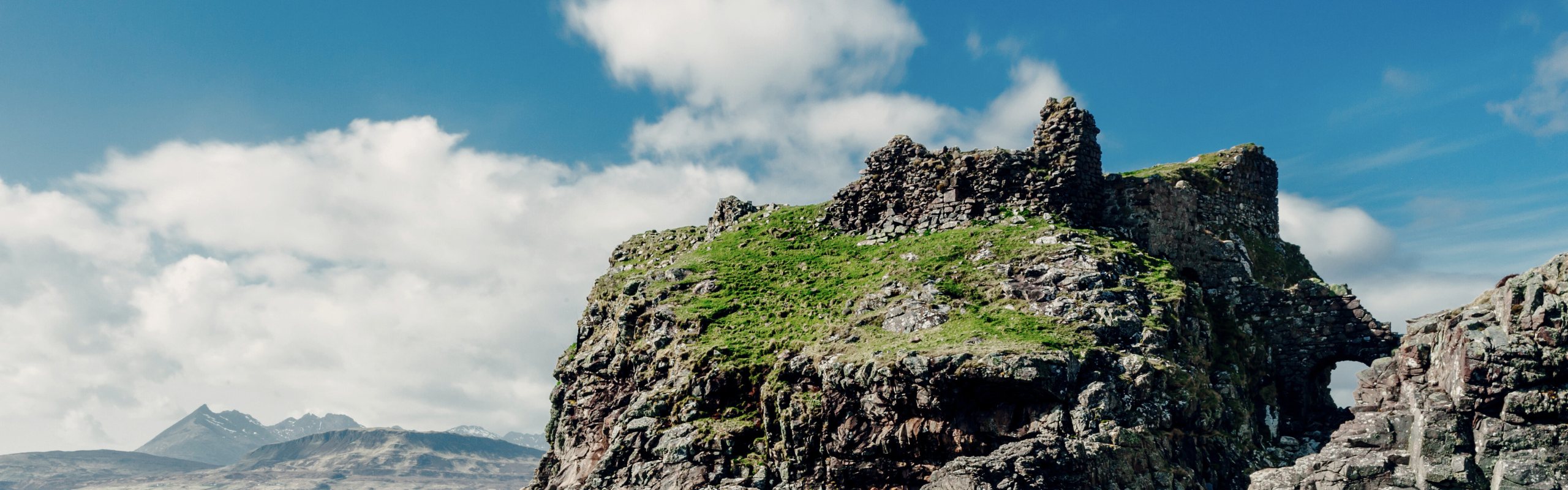
Only fragments of the original bridge remain, connecting the castle’s base to the nearby land. The floor of the bridge—most likely a wooden drawbridge—has vanished, leaving a sheer drop below. A narrow ledge runs along the base of the remaining side wall, allowing a cautious crossing, though the ledge is unforgiving to slips. Another way up involves scrambling along the rocks from the beach beneath, a practical option for anyone deterred by the bridge’s precarious remnants. The climb is manageable, yet it calls for steady steps and careful hands on the uneven stone. The surroundings, both rocky and open, reveal the structure’s location in a striking light, with Loch Eishort opening out to the north and east.
The Castle Ruins and its History
Little of Dunscaith Castle’s structure remains. Once on the upper level, the ruins give way to overgrown vegetation and crumbling stone, though remnants of the outer wall and stairway are still visible. The castle’s original construction date is unclear, though historical records suggest fortifications here since prehistoric times. It is believed the castle was first controlled by the MacAskills, followed by the MacLeods, before it became the stronghold of the MacDonalds of Skye.
In the fifteenth century, the McDonalds had regained Dunscaith and retained it until the clan’s relocation northward in 1618. With the granting of new lands in Trotternish by Royal Charter, the MacDonalds abandoned Dunscaith and established Duntulm Castle (in the far north) as their primary seat. The castle, though diminished, remains an enduring part of Skye’s landscape, and a reminder of more turbulent times..
Legends of Scáthach and Cú Chulainn
Beyond its physical history, Dunscaith Castle holds a place in Scottish legend. The fortress is said to be connected to Scáthach, a warrior-queen. Known for her skills in both combat and teaching, Scáthach trained many, including the Irish hero Cú Chulainn. According to legend, Cú Chulainn, famed for his strength and prowess, journeyed to Skye to study under Scáthach’s guidance. Here he learned the arts of battle. Scáthach’s instruction transformed him into the legendary figure celebrated in Irish folklore.
The site’s connection to Scáthach is commemorated in various accounts, some detailing her training of other young warriors, others describing her influence that stretched far beyond Skye’s borders.
Practical Advice for Visiting
The route to Dunscaith Castle involves navigating narrow, winding roads. A single-lane road from the A851 leads to Tokavaig, covering roughly eight miles. Parking can be found near the beach, though spaces are limited and not strictly designed for parking.
Sturdy footwear is essential, as the terrain includes uneven ground and occasional rocky sections. The bridge remains are best approached cautiously. The interior lacks formal preservation, with loose stones and little signage or informational boards. The open landscape provides a quiet setting, though as always weather can arrive suddenly.