
An Introduction to the Misty Isle
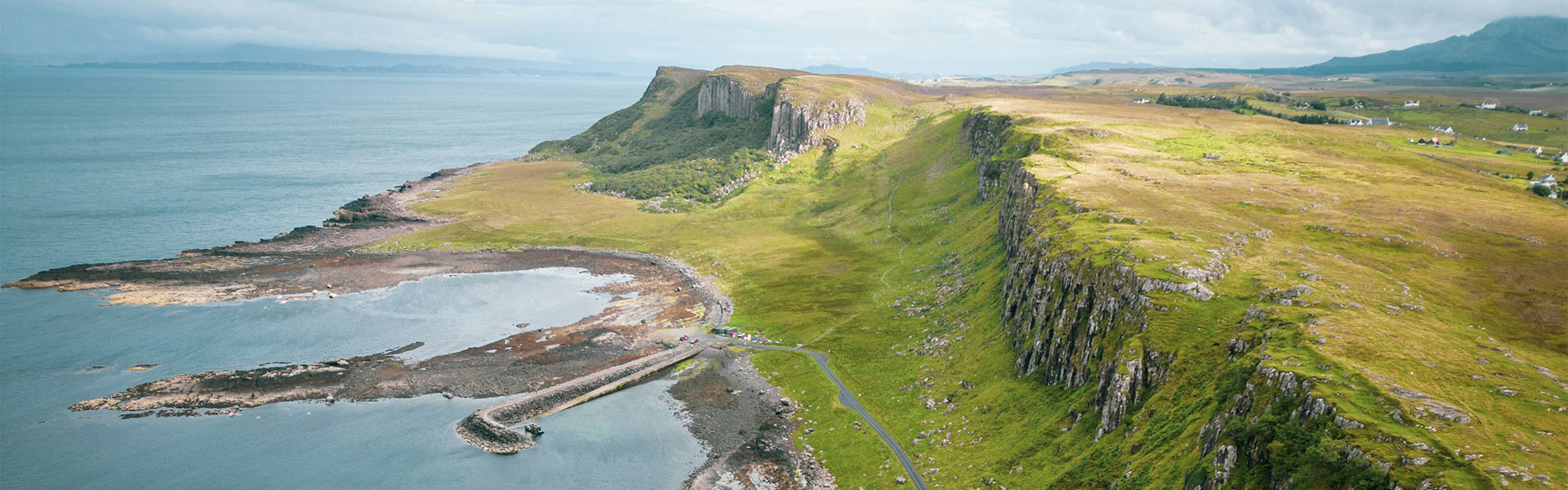
Off the northwest coast of Scotland lies the Isle of Skye, the largest and northernmost of the Inner Hebrides. The name ‘Skye’ likely comes from old Norse words Ski (cloud) and Ey (island), meaning ‘cloud island’. In Scottish Gaelic, it’s known as ‘An t-Eilean Sgitheanach’, which translates to ‘The Winged Isle’, a nod to the wing-like shape formed by its northern peninsulas of Waternish and Trotternish. Ancient Roman maps marked it as “Scitis”, while in English, it’s sometimes called the “Misty Isle” (Eilean a’ Cheo, in Gaelic).
Skye has long captured the imagination of visitors from around the world. Its combination of history, legends, scenery, weather, music, and poetry creates an atmosphere that draws people in, making it Scotland’s most visited destination after Edinburgh. The island’s ability to inspire awe in its visitors is a testament to its natural splendour. Some say that Skye serves as conclusive proof that, occasionally, nature was simply showing off.
Skye’s Geography and Landscape
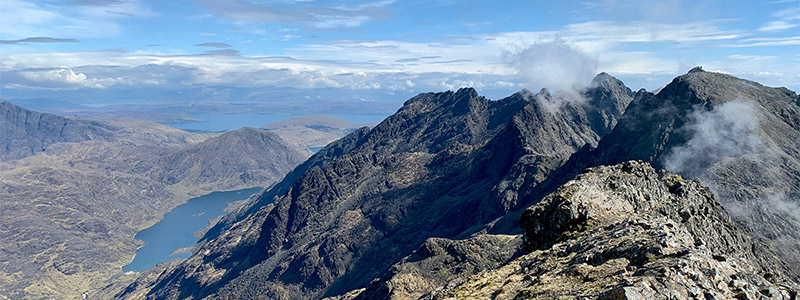
Skye stretches about 80 kilometres from north to south and 40 kilometres at its widest point from west to east. Its coastline is a complex network of bays and inlets, extending for some 640 kilometres. Every metre of this coastline offers something of interest, from sea arches and stacks to massive cliffs, waterfalls, fossils, and hidden caves. This dramatic shoreline provides a lifetime’s worth of exploration and discovery.
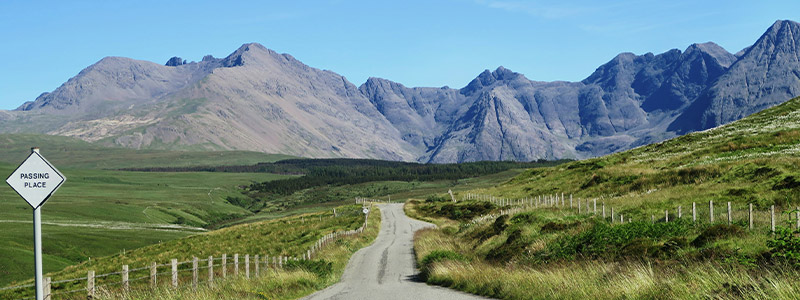
The island’s interior is equally diverse. The Cuillin mountain range dominates the landscape, often described as the only true mountains in Britain. Their jagged peaks and challenging ridges offer a stark contrast to the rounded granite forms of the nearby Red Hills, which provide their own stunning vistas.
In the northeast, the Trotternish Peninsula features a world-famous ridge that runs along its spine. This ridge reaches its zenith at the summit of the Storr, overlooking a landscape shaped by ancient landslips that includes the iconic Old Man of Storr. Nearby, the Quiraing presents another area of fascinating landslip topography, with its own set of pinnacles and gullies below the summit of Meal na Suiramach.
The southern Sleat peninsula offers a different face of Skye. Here, lush wooded glens intermingle with traditional crofting communities. The land here never rises above 300 metres, and its mild climate and fertile soil create a landscape more reminiscent of southwest England than northwest Scotland.
The Isle of Skye’s Geological Foundations
Skye’s varied terrain is a product of its complex geology. The island can be divided into three main geological regions, each contributing to its diverse landscapes. The impact of successive ice sheets, the most recent passing over as recently as 11,500 years ago, adds another layer to this geological complexity.
The southeast boasts some of Britain’s oldest rocks – Lewisian Gneiss dating back 3,000 million years. These ancient formations are overlaid with younger sedimentary rocks, primarily Torridonian Sandstone from about 800 million years ago.
The Cuillin range, in contrast, is a relative youngster. These mountains are the heavily eroded remains of a volcanic lava reservoir from about 60 million years ago. Just south of the Cuillin, limestone formations have given rise to cave systems in Strath Suardal. Metamorphosed limestone is still quarried as marble near Torrin, maintaining a longstanding industrial tradition.
Northern Skye is predominantly composed of lava flows. These horizontal layers built up to depths of around 600 metres, subsequently eroded by rivers and ice to create the flat-topped hills and stepped plateaux seen in the northwest. In Trotternish, the weight of this basalt caused underlying sedimentary rocks to collapse, resulting in the distinctive sideways-tipped landscape and ongoing ground movement evident in frequent rockfalls and road deformations.
The east coast of Skye, particularly in the Trotternish area, offers a fascinating glimpse into the island’s prehistoric past. Here, exposed Jurassic sediments contain numerous fossils, providing tangible links to Skye’s ancient history.
A (Very) Brief History of Skye
Skye’s history is as rich and varied as its landscape, with evidence of human activity stretching back millennia. The oldest signs of human presence date back to about 6,000 BC, when stone age hunter-gatherers left behind shell middens. Standing stones, some bearing Pictish carvings, dot the landscape, silent witnesses to ancient rituals and beliefs. Around 3,000 BC, the population began to settle into agricultural communities, leaving behind chambered burial cairns that can still be found across the island.
The iron age arrived late to Skye, around 500 BC. This period left its mark in the form of hut circles, duns, and impressive brochs – circular stone towers that served as both homes and fortifications. Underground storage passages known as souterrains also date from this era, demonstrating the ingenuity of Skye’s ancient inhabitants.
Viking rule began around 700 AD, when Norse settlers arrived from Norway. Their control lasted, not without dispute, until 1263 when they were defeated at the Battle of Largs. Skye then came under the control of the Scottish crown, but this didn’t bring an end to conflict on the island. Clan feuds continued to shape Skye’s history, with the conflicts between the Macleods of north Skye and the Macdonalds of south Skye being particularly numerous and fierce.
The island played a role in wider Scottish history too. After the Battle of Culloden in 1746, Bonnie Prince Charlie fled to Skye, aided by local heroine Flora MacDonald. Their journey is commemorated in the well-known Skye Boat Song, although the lyrics take some liberties with historical accuracy. Flora MacDonald’s grave can be found in the cemetery at Kilmuir, marked with an epitaph by Samuel Johnson praising her courage and fidelity.
The aftermath of the Jacobite rebellion brought significant changes to Skye, as it did to the rest of the Highlands. Traditional clan structures were dismantled, and the wearing of tartan, bearing of arms, and use of the Gaelic language were all outlawed. Clan chiefs became landlords, and their tenants became crofters.
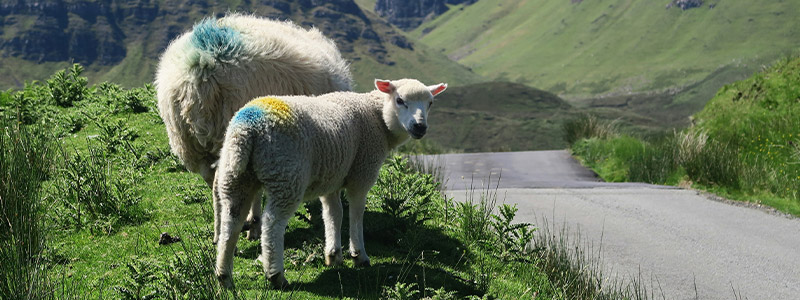
In the early 19th century, Skye’s economy was bolstered by the kelp industry. Seaweed was harvested and processed to make soap, fertilizers, and other products. However, when the market for kelp collapsed in the 1820s, landlords turned to sheep farming as their primary source of income, producing wool for the mills of the Industrial Revolution.
This shift led to the Highland Clearances, a turbulent period in Skye’s history. Many crofters were forcibly evicted to make way for sheep farming, leading to widespread emigration to mainland Scotland, Canada, and America. Some left voluntarily, seeking better opportunities elsewhere, while others were removed by force, their homes burned as they were expelled. The scars of this period can still be seen in the numerous abandoned settlements across the island, such as Suisnish, Boreraig, Lorgill, and Tusdale.
The Isle of Skye Today
Today, Skye is experiencing a resurgence. The island’s population reached its lowest point in the mid-20th century but has since rebounded. The current population stands at about 13,100, having grown significantly in recent decades. The island is attracting newcomers drawn by its quality of life and access to nature.
The availability of broadband internet has enabled new types of remote work, allowing for a new kind of cottage industry to flourish. The rate of business start-ups is the highest in the Scottish Highlands, indicating a vibrant and diversifying economy.
Tourism continues to be a major economic driver, with visitors drawn by the island’s natural beauty, outdoor activities, and rich cultural heritage. The construction industry is also thriving, with ongoing house building and renovation projects keeping hundreds of people employed.
Despite the challenges it has faced, Skye has proven resilient. Its communities are vibrant, its economy is diversifying, and its future looks promising. For visitors, the island offers a unique blend of stunning landscapes, rich history, and modern amenities, making it a truly captivating destination.
The Isle of Skye stands as a testament to the ongoing appeal of Scotland’s natural beauty and cultural heritage. From its ancient geological formations to its modern-day renaissance, Skye continues to captivate and inspire. Whether you’re drawn by its rugged mountains, its dramatic coastlines, its rich history, or its thriving contemporary culture, Skye offers an experience that lingers long after you’ve left its shores. As you explore this extraordinary island, you’ll understand why it has been a source of fascination for countless generations, and why it continues to be one of Scotland’s most treasured destinations.