
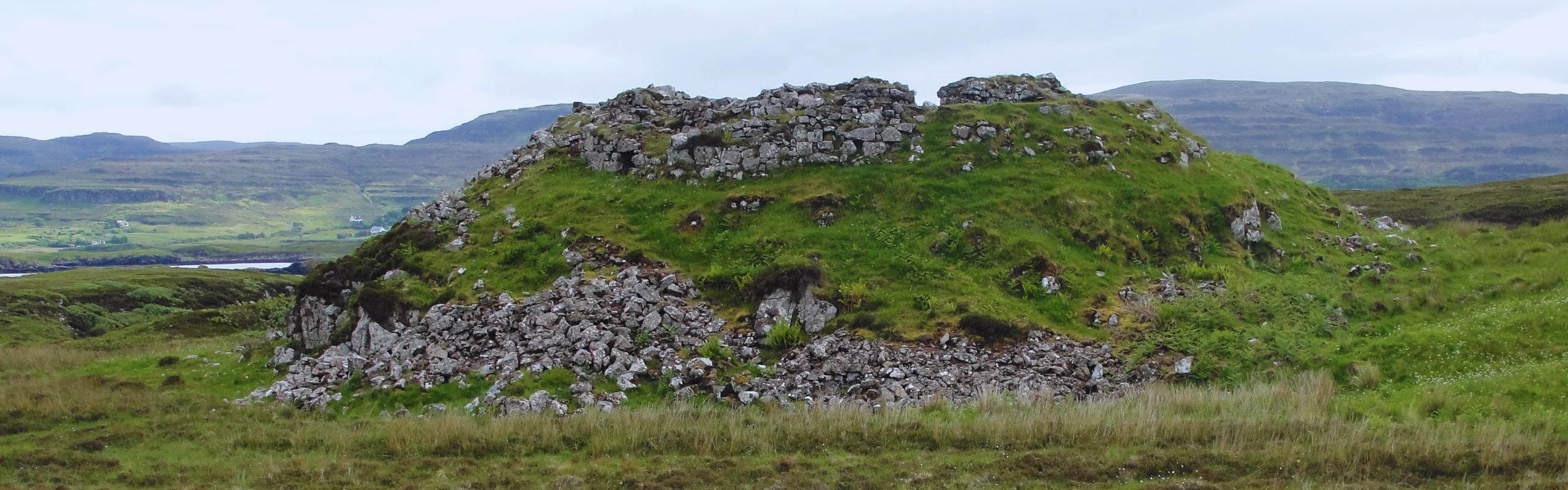
Dun Fiadhairt – John Allan
The Fiadhairt peninsula, at Loch Dunvegan on the Isle of Skye, is a relatively unknown area of the island. Just 15 minutes from the main road north of Dunvegan, it remains secluded, and a beautiful setting for watching the area’s wildlife, including a nearby seal colony. At the centre of this peninsula stands Dun Fiadhairt, one of the best-preserved Iron Age brochs on Skye. This ancient structure, with its substantial stone walls and inner passageways, serves as a focal point for the area, with clear views of the surrounding area, perfect for enjoying the view and spotting incoming invaders. There is a small off road area where you can park at (///victor.towers.political) The walk begins at a gate near (///expert.still.delusions), from where a rough track leads towards the broch at (///desiring.armed.those).
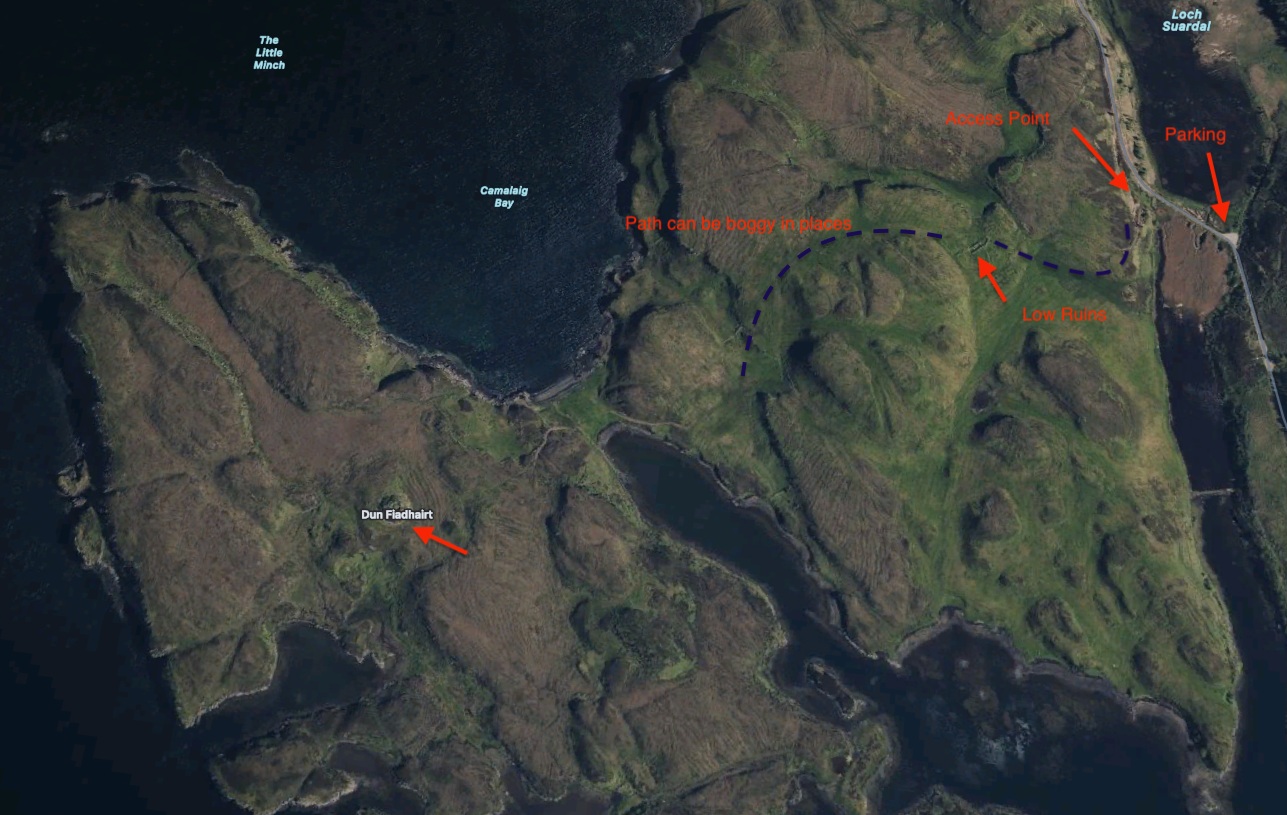
Approaching Dun Fiadhairt Broch
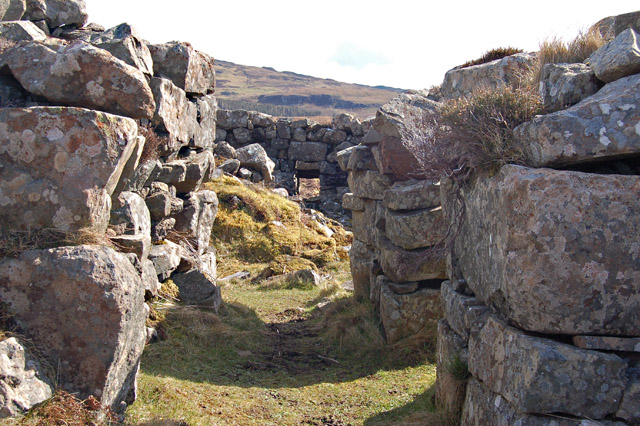
From the starting point, a worn track ascends a small hill towards some low ruins. The path briefly vanishes at the ruins but reappears beyond, becoming a grassy surface that crosses pastureland. It then descends towards a narrow isthmus (a narrow strip of land that connects two larger landmasses) connecting the peninsula to Skye. The broch’s distinctive circular structure becomes visible on approach, positioned prominently on a rise. Dun Fiadhairt’s walls remain intact, forming a perimeter around a central area with two entrances, an intra-mural passage, and several still-visible stairways.
The broch’s architecture is a beautiful example of Iron Age construction. Dun Fiadhairt’s has a double-walled design with covered passageways. Inside the broch, visitors find spaces that spark the imagination of daily life and defensive measures from a time long past. Walking through the broch’s main entrance reveals the scale of its interior layout, a space fortified by stone walls that rise to nearly head height in some sections.
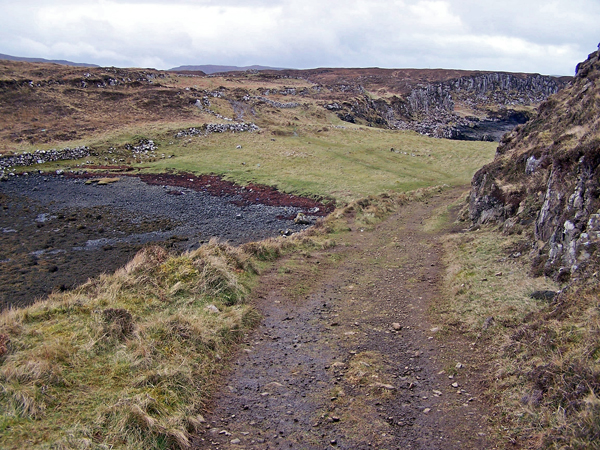 Track to Fiadhairt- Richard Dorrel
Exploring Fiadhairt Peninsula’s Natural and Historical Landscape
After visiting the broch, walkers can explore various parts of the Fiadhairt peninsula. To the north, sea cliffs provide views across Loch Dunvegan’s mouth, while the southern reaches of the peninsula feature an intricate array of inlets, rocky shores, and open moorland. Opposite the peninsula, across a narrow waterway, lies Gairbh Eilein, where boats from Dunvegan Castle regularly ferry visitors to observe the area’s seals. The shores of Fiadhairt itself offer quieter viewing points for observing these animals, with many seals resting on the rocks close by.
Fiadhairt’s rugged landscape has a mixed terrain that can be boggy in places, requiring good footwear for those exploring the area extensively. The presence of ticks in areas like this should be noted especially during the warmer months, highlighting the importance of being prepared for the conditions in this secluded area (high socks and covered ankles). Nonetheless, the broch itself is easily accessible, and its partially intact structure draws attention early in the walk.
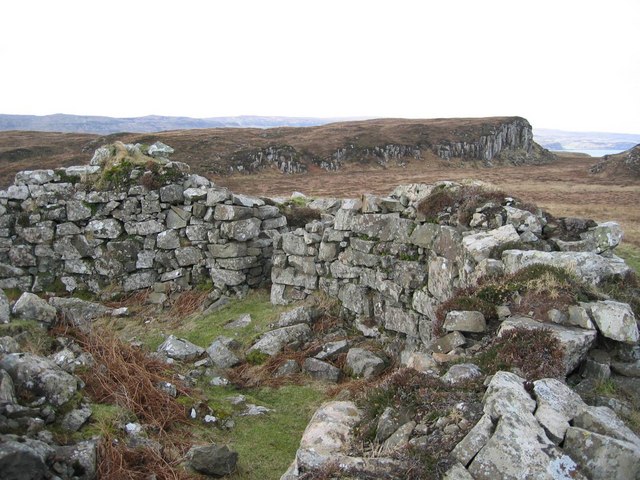
Dun Fiadhairt – John Allan
Historical Finds and Dun Fiadhairt’s Roman Connections
Dun Fiadhairt is not only notable for its lasting structure but also for the artefacts discovered here, which suggest links to far off lands. Excavated in 1914 by F.T. MacLeod, the broch yielded several items that shed light on its historical significance. As MacLeod recorded, “Finds included an amber necklace, various beads, with one dating from probably the 2nd Century AD., and a terra-cotta model of a bale of wool indicating links to Romanized Britain.” Further excavations by Curles & Mann made “… the discovery of a small terra-cotta votive (an object that was given as an offering) in the form of a model of a bale of hides or fleeces at the broch and suggest that it was probably brought by a trader from the south during the Roman period, as the local population did not use terra-cotta.”
These finds indicate that Dun Fiadhairt may have held a role not only as a local structure but as a point within a broader network of trade. The discovery of imported items such as terracotta, along with items crafted from amber, implies a flow of goods and perhaps ideas between Skye and the Romanised communities of Britain. This evidence situates the broch within a historical context that reaches beyond its immediate surroundings, hinting at a link between Skye’s Iron Age society and the wider Roman world.
Practical Information for Visiting
To visit the Fiadhairt peninsula, take the minor road that extends from the A850 after Dunvegan, parking just as the road crosses a loch. From this point, follow the path to the left, which heads up the hill towards the initial set of ruins. Although parts of the trail may be boggy, the grassy path soon descends towards the isthmus, where Dun Fiadhairt’s circular structure becomes visible ahead. Once at the broch, visitors can observe features such as the intra-mural cells and a ground-level gallery within the walling, as well as substantial entrances flanked by stonework.
For those seeking a quiet experience on Skye, the Fiadhairt peninsula combines the natural beauty of an undisturbed landscape where your imagination of Skye’s history can run wild.
You can have a look at the excavation documents here.