
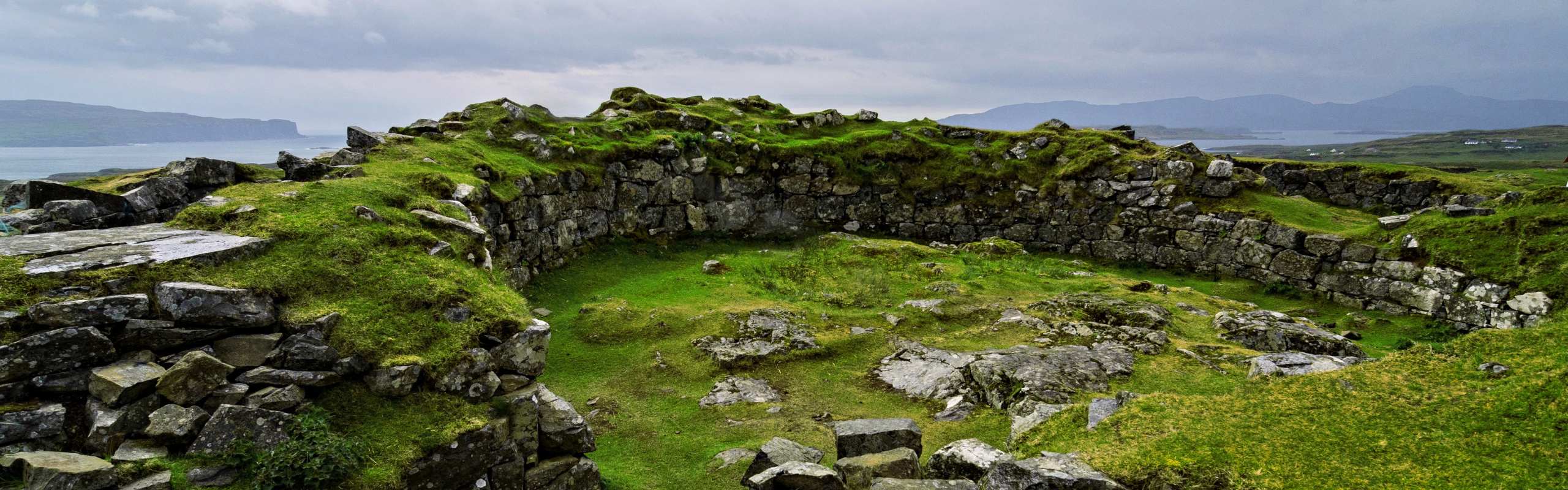
Skye’s Best-Preserved Broch and Its Forgotten Neighbor, Dun Mor
- Last Updated:
Dun Beag Broch is one of the best-preserved examples of Iron Age stone towers on the Isle of Skye. Located just off the A863 between Dunvegan and Sligachan, this historical site offers a fascinating glimpse into Scotland’s distant past. Though now partially in ruins, the broch’s towering walls and defensive design still stand out today.
How to Get There
Accessing Dun Beag is straightforward. From the main road, there’s a small car park at IV51 9DG, where a signpost and information panel will guide your way. The walk up to the broch is short and easy, taking you through a sheep-grazed pasture and up a gentle hill. Though the terrain is not challenging, be sure to wear good footwear, as it can be a little muddy at times.
For those with more time and energy, there’s an option to visit Dun Mor, another broch located about 0.5 km further along a small path. To reach it, start by heading back towards the road from Dun Beag, then take the path to the north-west. Follow the line of an old wall to reach Dun Mor, found at wizard.jobs.contoured.
What to Expect
Dun Beag is a classic example of a Scottish broch, featuring a double-wall construction. These thick walls would have once supported several storeys, with traces of a narrow stairway still visible today. Walking around the site, you can explore what remains of its entrance, a small guard chamber, and remnants of upper levels that likely served as a lookout.
Though much of the structure has worn down over the centuries, with walls standing up to 2 metres high, it’s easy to imagine how this ancient fortification once looked. The design reflects its dual purpose as both a residence and a stronghold, likely housing a community that valued security and social standing.
Views and Atmosphere
The site’s elevated position offers impressive views across Loch Bracadale and the surrounding landscape. On a clear day, you can take in panoramas of Loch Harport and the Cuillin mountains in the distance. It’s a peaceful spot, often occupied only by grazing sheep, making it easy to imagine life here thousands of years ago.
Even though Dun Beag is among the most accessible brochs on Skye, it retains a quiet and undisturbed atmosphere, far from the busy tourist spots. The surrounding area is virtually untouched, giving you a sense of stepping back in time.
Historical Significance
Dun Beag dates back over 2,000 years, likely built between 200 and 500 BC. Although the site was later reoccupied in medieval times, its Iron Age origins are still evident. The purpose of brochs is debated among historians, but it’s clear that these structures were both homes and symbols of power. The double walls would have provided insulation and protection, while their height allowed for a commanding view of the surrounding area.
Interestingly, Dun Beag isn’t the only broch on Skye. Over 50 such structures have been identified across the island, though few are as well-preserved as this one. This makes Dun Beag a key site for understanding the prehistoric architecture and social structure of the time.
Practical Tips
- Parking: Available at IV51 9DG, across from the broch.
- Footwear: Sturdy shoes are recommended, especially in wet weather.
- Accessibility: The walk is easy, but not suitable for those with limited mobility.
- Time: You can explore the site in about 30–60 minutes.
- Nearby: Combine your visit with other nearby attractions like the Fairy Pools or Talisker Distillery, both within a short drive.
For anyone interested in Scotland’s ancient history, Dun Beag offers a rare chance to walk through a site where the past feels very much alive. Whether you’re here for the historical significance or simply to enjoy the stunning views, Dun Beag is well worth a stop on your Isle of Skye adventure.